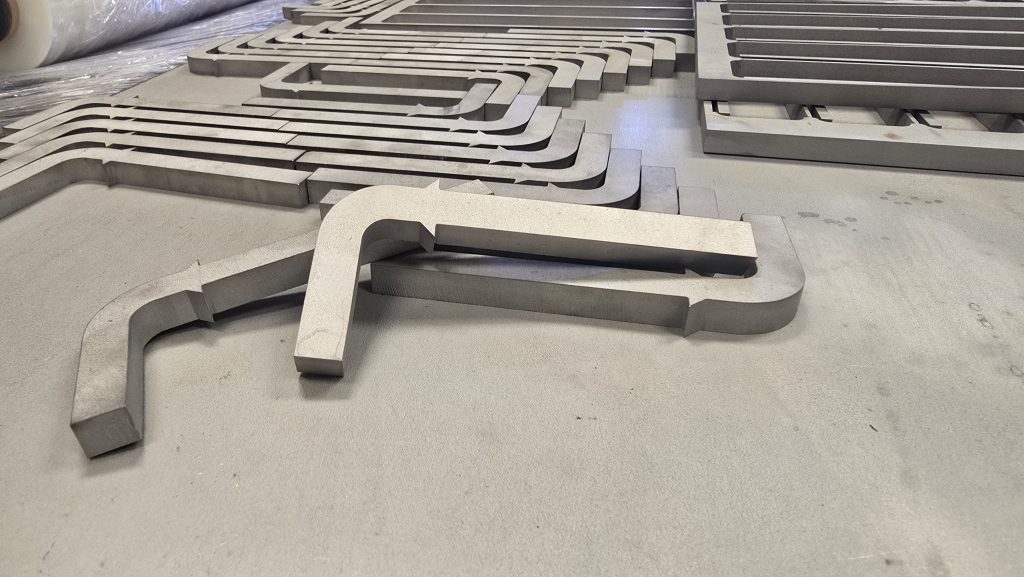
Laser and waterjet both cut flat profiles from a CAD file, and both get quoted for the same jobs. They are not interchangeable. The right one depends on the material, the thickness, and what happens to the part after it leaves the bed.
Part Engineering runs an abrasive waterjet in Osborne Park, not a laser. When a laser is the better buy for your part, we will say so.
How each one cuts
A laser melts or burns a narrow line through the sheet with a focused beam, and a gas jet blows the molten material out of the cut.
An abrasive waterjet pushes water through a small orifice at around 60,000 psi, mixes in garnet, and erodes the material away. Nothing is melted. The cut stays cold.
Where laser wins
- Thin sheet steel at volume. On thin mild steel, stainless and aluminium, a laser is much faster, and speed is most of the price.
- Fine detail in thin sheet. The beam is narrower than a waterjet stream, so very small features and tight inside corners in thin sheet suit a laser.
- Large runs of simple parts. Thousands of identical thin brackets are laser work.
Where waterjet wins
- No heat-affected zone. Heat changes the metal along a laser edge. On most mild steel brackets that does not matter. On wear plate, hardened steel, titanium, and heat-treated parts it does: the edge is no longer the hardness on the certificate. Waterjet leaves the edge as the material arrived. We wrote more about this in why a torch-cut wear plate fails early.
- Materials a laser cannot or should not cut. Stone, glass, tile, rubber, foam, gasket sheet, composites, and many plastics. Heat melts plastics, burns rubber, and can strip the resin out of carbon fibre. See why rubber, foam, and composites are cut cold.
- Thick plate. A laser slows down and loses edge quality as plate gets thicker. Waterjet keeps cutting thick steel, aluminium, and stone where a laser runs out of power.
- Reflective metals. Copper, brass, and polished aluminium can be awkward on some lasers. Waterjet does not care how shiny the sheet is.
- Mixed jobs. The same bed cuts stainless in the morning and rubber or glass in the afternoon, so one supplier handles the whole kit of parts.
Edge and accuracy
A laser edge on thin sheet is clean and square. On thicker plate it can show striations and a little taper, and there may be dross underneath.
A waterjet edge has a fine, even, satin finish. A plain waterjet stream leaves a slight taper on thick material. Our machine has Tilt-A-Jet, which tilts the head to cancel that taper, so walls come off square on precision and heavy-section work.
Cost
On thin sheet, laser is usually cheaper per part because it cuts faster. As thickness goes up, or as the material moves away from plain steel, waterjet becomes competitive and then the only option. A secondary step matters too: if a laser-cut edge has to be machined back to remove the hardened zone, that cost belongs in the comparison.
A quick way to decide
- Thin mild steel, stainless or aluminium, large quantities, nothing heat-sensitive: get a laser quote.
- Thick plate, hardened or heat-treated material, titanium, or anything that cannot take heat: waterjet.
- Stone, glass, rubber, foam, plastics or composites: waterjet.
- A mix of materials in one job: waterjet keeps it under one roof.
Send the file through the quote page with the material and thickness, or read the waterjet service. If the part is a better laser job, we will tell you.