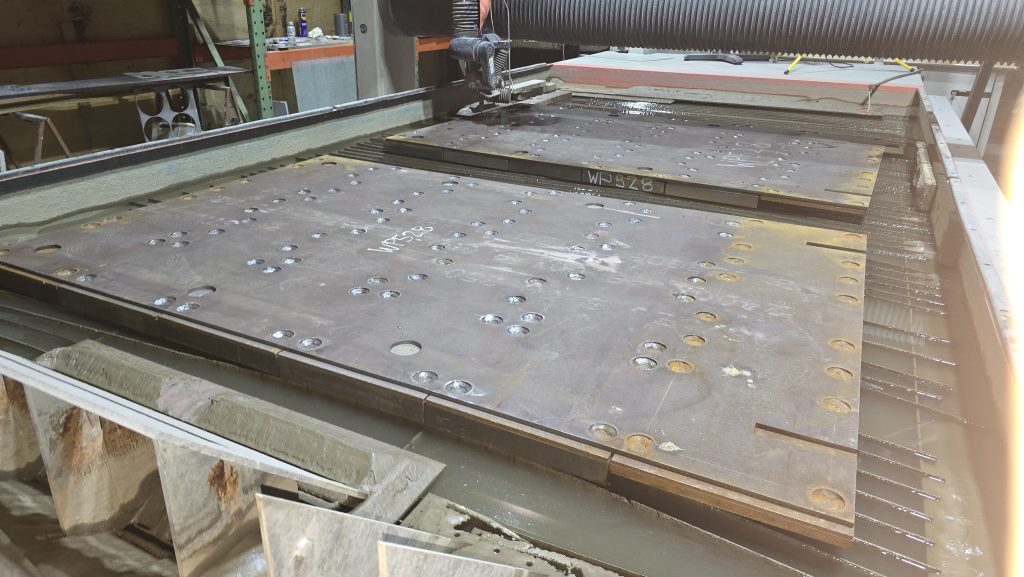
A CNC mill can cut almost any shape, including flat profiles. A waterjet can only cut through the sheet, in two dimensions. So why not mill everything? Because milling a flat outline out of plate is slow, wears tools, and turns most of the plate into chips.
Part Engineering runs both in Osborne Park, so most of the time the answer is to use each for the part of the job it does best.
What each one does
A CNC mill removes material with a spinning cutter. It makes pockets, steps, threads, chamfers, 3D surfaces, and faces flat to a fine finish. Our mills include a 5-axis with 880 × 880 × 800 mm travel and a 4-axis with 1500 × 660 × 660 mm travel.
An abrasive waterjet cuts straight through the material along a 2D path, using water at around 60,000 psi with garnet, across a programmed travel of 4064 × 2032 mm.
Where waterjet wins
- Flat profiles. Brackets, plates, flanges, gaskets, and outlines are much faster on the waterjet.
- Material use. Parts are nested on the sheet and the offcut stays usable, instead of being milled away.
- Large sheets. A full sheet goes on the waterjet bed, while a mill would need several set-ups.
- Hard and difficult materials. Wear plate, titanium, and hardened steel cut without heat or tool wear. Stone, glass, and rubber cut the same way.
- No clamping stress. Thin parts are not pulled out of shape by cutting forces.
Where milling wins
- Anything that is not a through-cut. Pockets, counterbores, steps, threads, and 3D forms.
- Precision faces and bores. Bearing seats, sealing faces, and tight fits.
- Fine finish. A milled surface is smoother than a cut edge.
The usual split
1. Waterjet cuts the outline and through-holes from plate, often several parts from one nest.
2. The mill adds pockets, threads, faces, and the tight features.
Starting from a near-net waterjet blank means less machine time and less waste than milling from a solid block. For round parts, our turn-mills take the same approach.
A quick way to decide
- Flat part, through features only: waterjet.
- 3D shape, pockets, threads, or tight fits: mill.
- Flat part with a few machined features: waterjet the blank, then mill.
Send the drawing through the quote page and we will plan the route. See the waterjet service and CNC machining.